
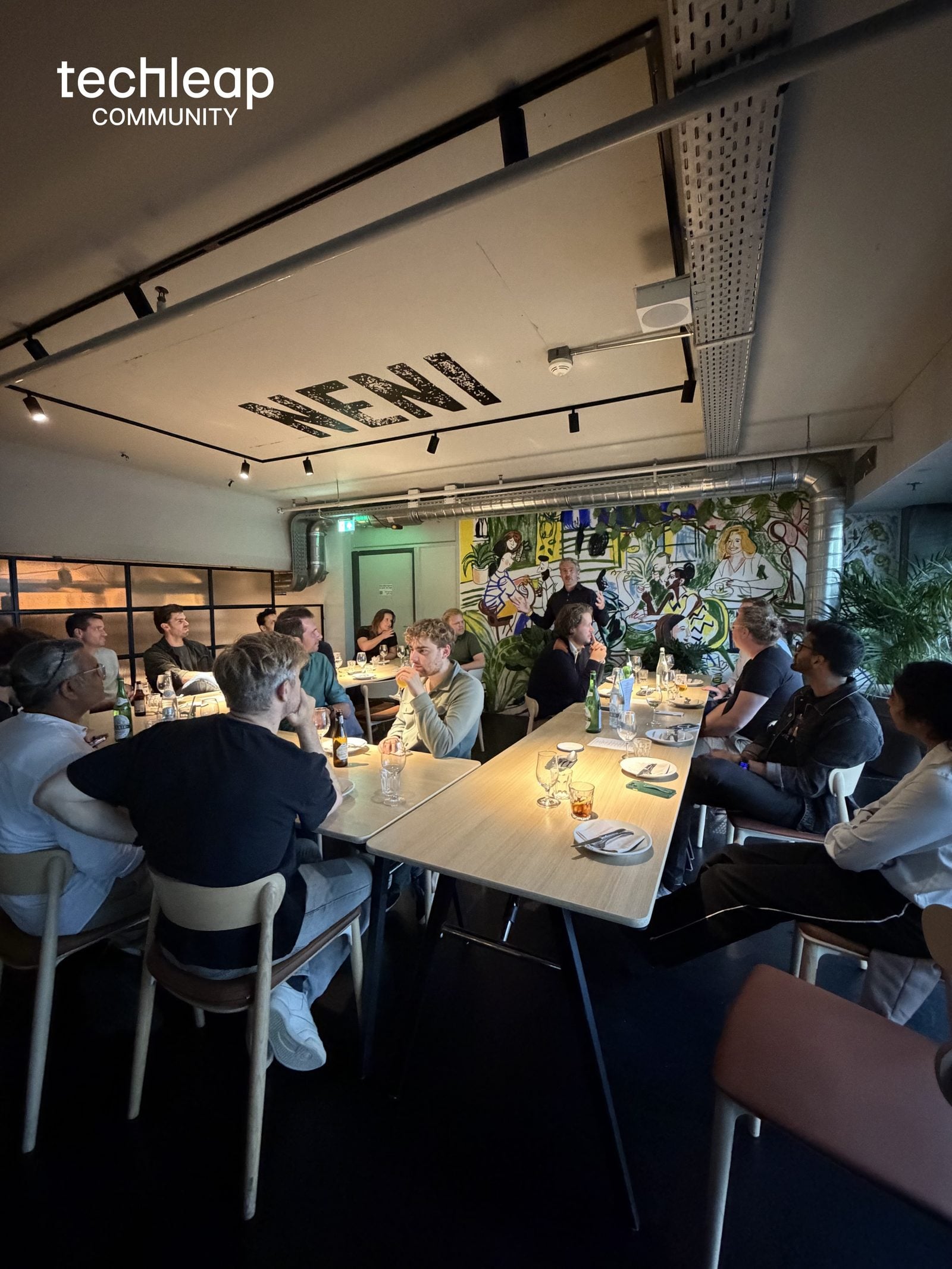
We asked whether AI is a coworker or a replacement. The table stopped being polite.
Twenty-two companies at one long table at Neni, from AI-native startups to Booking.com, bunq, Picnic, Miro and Dott. One shared conversation, three hours, Chatham House rules. The split that opened up was not about the technology. It was about whether anyone would say out loud what their product actually does to headcount.
By the numbers
The argument that broke out
Agents or coworkers. The question sounds academic until someone at the table sells the thing that decides it.
- The disagreement was about honesty, not technology Nobody at the table doubted that the agents work. What split the room was whether founders will say plainly what their product does to headcount, or keep selling it as augmentation because that is the easier sentence.
- Both sides of the jobs argument were well made History is on one side: every efficiency gain so far has produced more usage rather than less, and the work has never run out. The counter is that each previous shift moved people out of physical work and into mental work, and this one is coming for the mental work too.
- It is a question of pace, not direction That is where the room actually landed. Farming went from ninety per cent of the workforce to two, and it had two hundred years to do it. Nobody at the table thought this one gets two hundred years, and the pace is what makes it a live problem rather than a historical one.
- The median job goes before the profession does The uncomfortable corollary nobody argued with. If the strongest ten per cent of practitioners end up carrying eighty per cent of the work, the profession survives in name while most of the people in it do not.
What else came up
Four threads that had nothing to do with headcount and were worth the evening on their own. Members get the full write-up in the Hub.
- Frontier models follow instructions better and wander worse. More than one team at the table reported it independently, and the gap is widest on long-horizon work measured in days rather than minutes.
- Natural language is probably not the destination. Ask for a red circle and by the fourth correction you have written a specification, so expect formal and semi-formal language to come back.
- Discovery is already being done by machines. One company at the table had to push current-version signals into training data because models kept recommending the release before last.
- Taste is the contrarian bet. What was cheap becomes premium once it turns rare, and people admitted to reading a typo as evidence that a human wrote the thing.
Who was at the table
Twenty-two companies, one conversation. Held under Chatham House rules, so nothing here is attributed.
The follow-up
The dinner surfaced the questions. The Autumn Gathering on 30 September is where we work on them.
- Jim Lecinski, twelve years at Google and now teaching at Kellogg, opens with research on why AI initiatives stall and what turns them into lasting value.
- Deepak Singla, co-founder of Fini, was at this table on Monday and takes the practical half on the 30th: the company brain a redesigned team needs before it can function.
- Then discussion tables, and dinner after, with the community in the room. Miro, Amsterdam, 16:30 to 21:00.
Want a seat at the next table?
Connect Dinners are for members. One long table, one shared conversation, Chatham House rules, and a write-up like this one afterwards. We keep them small so that everyone gets to speak.